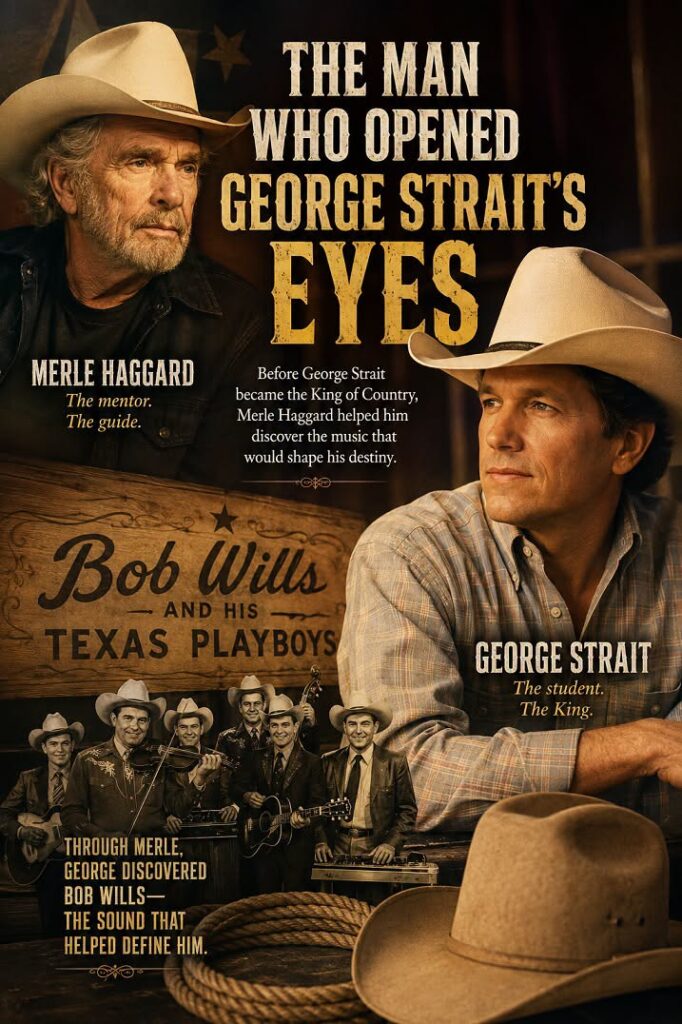
Long before George Strait earned his crown as the “King of Country,” he was just a young Texas cowboy searching for his place in the music world. In the early 1970s, Strait wasn’t entirely sure what kind of country artist he wanted to be.
That all changed when he stumbled upon a record by country icon Merle Haggard—a discovery that altered the course of country music history forever.
The Early Search for a Musical Identity
In the early 1970s, while serving in the U.S. Army in Hawaii, George Strait was honing his vocal craft. He loved country music, but he hadn’t yet found the signature style that resonated with his roots.

The turning point came in 1970 with the release of Merle Haggard’s seminal tribute album:
“A Tribute to the Best Damn Fiddle Player in the World (or, My Salute to Bob Wills)”

When Strait put that needle on the record, something clicked immediately. Haggard didn’t just deliver a collection of catchy tracks; he offered a masterclass in authentic Texas music.
Discovering the Heart of Texas Western Swing
Haggard’s tribute introduced Strait to the infectious, danceable rhythm of Texas Western Swing. It was a sound steeped in tradition, defined by:
Twin fiddles soaring over driving rhythms
🤠 COMMUNITY VOICE
Who do you think deserves the crown for the Ultimate Country Legend?
Submit & See ResultsLively steel guitar riffs built for Texas dance halls
An unmistakable, unapologetic Lone Star character

Haggard didn’t just give Strait songs to study—he gave him a roadmap. The swing, the fiddle, and the storytelling gave Strait the blueprint for the artist he was destined to become.
The Bridge to Bob Wills and The Texas Playboys
Through Haggard, Strait discovered the legendary Bob Wills—the undisputed King of Western Swing.
Because Bob Wills was near the end of his career when Strait was coming of age, Haggard acted as the vital bridge connecting two generations. Strait soaked up Wills’ influence through Haggard’s fresh lens, adopting that classic swing as the backbone of his own sound.
When Strait returned to Texas and formed the Ace in the Hole Band, they took that exact Western Swing sound straight to the local dance halls, honing the live performance style that would soon conquer Nashville.
Sparking the Neotraditional Country Movement
By the early 1980s, mainstream country music in Nashville was drifting heavily toward pop crossover production. Armed with the traditional influences of Haggard and Wills, George Strait spearheaded the Neotraditional Country movement.
Honoring the Roots: Strait regularly covered Haggard and Wills classics, including hit renditions of “Right or Wrong” and “Ida Red.”
A Lifelong Respect: Throughout his Hall of Fame career, Strait has repeatedly named Merle Haggard as his single biggest musical influence.
Final Thoughts
The story of Merle Haggard opening George Strait’s eyes is one of the greatest mentorship tales in American music history. Haggard didn’t just pass down a genre; he helped George Strait find his soul as an artist—and in doing so, preserved the heart of real country music for generations to come.