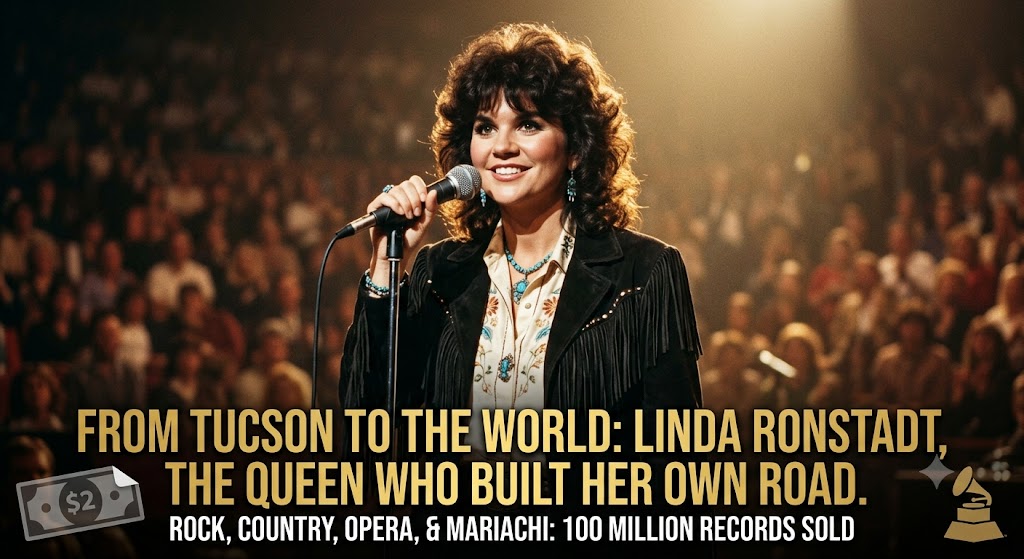
In 1964, an 18-year-old girl left her hometown of Tucson, Arizona, bound for Los Angeles. She had exactly $30 in her pocket and a single $2 bill with a torn corner—a parting gift from her father for good luck.
Nobody in California knew her name. Yet, by the end of the 1970s, she would become the top-grossing solo female concert artist in the world.
Her name is Linda Maria Ronstadt, and her journey is the ultimate testament to what happens when an artist refuses to compromise her vision for the sake of the music industry’s rules.

Music and Audio
Born into a Musical Birthright
Music was never just a hobby in the Ronstadt household; it was a legacy. Born on July 15, 1946, Linda grew up on a 10-acre ranch that her family had owned for generations. Her grandfather, Federico José María Ronstadt, had immigrated to Tucson from Sonora, Mexico, in the late 1800s, establishing deep roots in the local culture by leading the town’s brass band.
Every evening, Linda’s childhood home filled with an eclectic mix of opera, jazz, American standards, and traditional Mexican folk songs. By age six, Linda knew exactly what she wanted to be: a singer.

Breaking Through: The Stone Poneys and the Battle for Identity
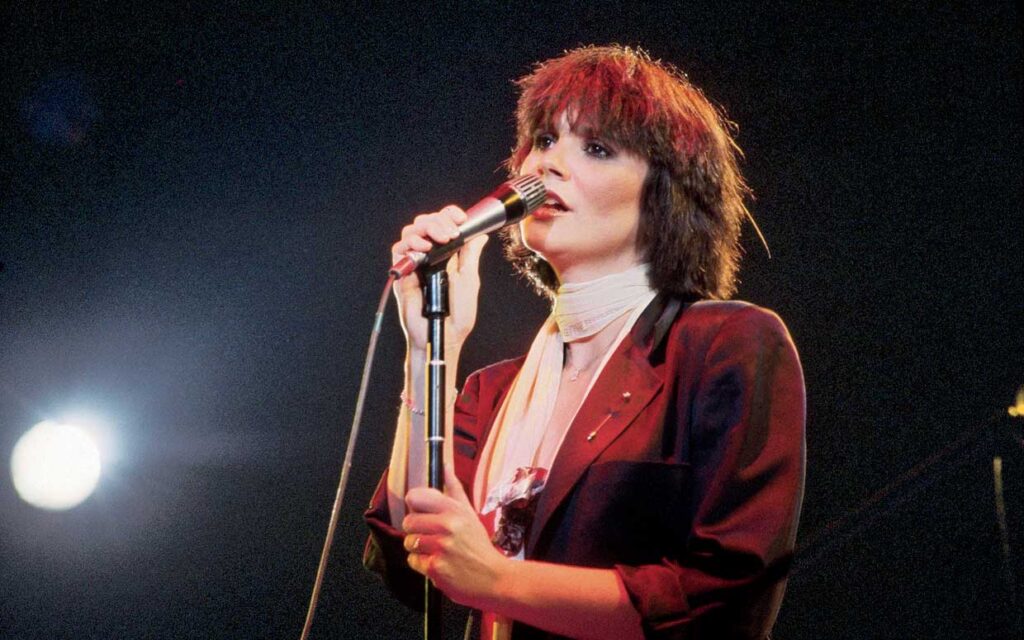
After just one semester at the University of Arizona, Linda dropped out and headed to LA, chasing the folk-rock revolution. Alongside musicians Bob Kimmel and Kenny Edwards, she formed The Stone Poneys. In 1967, their track “Different Drum” (written by Michael Nesmith of The Monkees) became a nationwide radio hit.
But when the band dissolved, Linda went solo—and hit a wall. She crosses between country and rock in ways that confuse programmers and frustrate executives. She is told, repeatedly, that she needs to pick a lane.
For five years, record labels didn’t know how to market her. Executives practically begged her to “pick a lane”—either stay in country or commit to rock. Linda chose a third option: she built her own road.
🤠 COMMUNITY VOICE
Who do you think deserves the crown for the Ultimate Country Legend?
Submit & See Results1974: The Turning Point of Heart Like a Wheel
On November 19, 1974, Linda released her fifth solo album, Heart Like a Wheel, produced by the legendary Peter Asher. It didn’t just break boundaries; it completely shattered them.
-
The Impact: The album sold over 1 million copies.
-
The Chart Success: It simultaneously topped both the pop/rock and country charts.
-
The Recognition: It earned her four Grammy nominations and her first Grammy win for Best Country Vocal Performance.
Linda proved that a woman could dominate the rock world while staying deeply rooted in country music.

The Golden Decade of the 1970s
Following that breakthrough, Linda launched a streak of platinum-selling, chart-topping albums that defined a generation:
-
Simple Dreams (1977)
-
Living in the USA (1978)
-
Mad Love (1980)
By the end of the decade, Cashbox magazine named her the No. 1 Female Artist of the Decade. She became the first woman in history to successfully pack massive arenas on a major touring circuit.
Conquering Broadway, Standards, and Her Mexican Heritage
Just when the industry thought they had her figured out as a rock goddess, Linda pivoted again. In 1981, she defied critics by taking the Broadway stage in the New York City Opera’s production of The Pirates of Penzance, earning rave reviews for her flawless classical vocals.
Next, she teamed up with iconic big-band arranger Nelson Riddle to release a trilogy of traditional pop standards albums (What’s New, Lush Life, For Sentimental Reasons). Industry insiders called it commercial suicide; audiences turned all three into multi-platinum bestsellers.
Then came her most personal triumph. In 1987, she recorded Canciones de Mi Padre, an album entirely sung in Spanish to honor her grandfather’s heritage. It defied American radio standards to become the best-selling non-English-language album in U.S. history at the time.
The Diagnosis and an Enduring Legacy
Over her historic career, Linda Ronstadt:
-
Released 24 studio albums
-
Sold more than 100 million records worldwide
-
Won 11 Grammy Awards across multiple genres
In December 2012, Linda revealed a heartbreaking diagnosis: Parkinson’s disease (later revised to progressive supranuclear palsy). The degenerative neurological condition permanently took away her ability to sing. She hasn’t performed publicly since 2009.
Yet, even without her physical voice, her presence remains monumental. In 2014, she was rightfully inducted into the Rock and Roll Hall of Fame, and President Barack Obama awarded her the National Medal of Arts.
The Ultimate Lesson from Linda Ronstadt
Today, at 79, living a quiet life in San Francisco, Linda Ronstadt’s story remains a guiding light for independent creators everywhere.
She proved that you do not have to fit into a corporate box to achieve greatness. Her life teaches us the ultimate creative truth: The greatest artists don’t pick a lane—they build their own road entirely.